
One of the first things I noticed when I moved to Atlanta was the trees. Atlanta and North Georgia, in general, have these sloping, hilly landscapes punctuated by magnificent trees. Some reach into the sky. Others have wide trunks reminiscent of the Pocahontas Grandmother Willow.

Therefore, it is a deep irony that instead of following the long-standing convention of naming streets after a variety of different trees, i.e., Elm Street or Magnolia Blvd. They named half of the streets “Peachtree Street.” Not only the roads but also many buildings are named Peachtree, and Peachtree is plastered on a majority of the signage.
Aside from choosing a tree that lacks the striking silhouette against the skyline that many of the other Georgian trees provide, this naming convention has led to the unfortunate situation that whenever I get in my car, I know I am going somewhere named Peachtree, but I never know where that is.
Luckily, we live in an advanced age where the GPS on my cell phone is up to the complicated task of finding the correct Peachtree address and guiding me on my way.
Frankly, I am not surprised the Atlantans of old chose this naming convention. Old cities have a wisdom about them. They understand complex problems are usually more important than complicated problems.
Complicated problems may be daunting, but they have solutions. With sufficient analysis, you can theoretically find the correct answer.
For example, dividing 4,392 by 56 without a calculator is complicated. Finding the right move in Chess is super complicated. The GPS finding the correct Peachtree address is almost infinitely complicated. But none of them are complex.
Complex problems are not wholly solvable. You may solve it one day, but then the next, the opposite problem will pop up in its place. Or you just don’t have, and will never have, enough information to know where to go.
For instance, treating mental health conditions is usually complex. Along with deciding who to vote for, figuring out who to marry, or deciding whether or not to have kids.
If you are deciding whether to quit your stable job and risk it all to follow your passion, a list of pros and cons will only take you so far.
For these complex problems, you’d be better off listening to music, reading a classic novel, or sitting under the stars in wonder. You might find something in the complexity of the universe or the complexity of the human heart that you could never calculate from scratch.
When I started this blog, I thought most of my posts would be data deep dives into the demographics of different places or analytical posts about the inner workings of social networks. Surprisingly, I have found myself more interested in writing about the poetic nature of the journey because I appreciate the complexity of our current moment (And the fact these posts don’t take as much time to write.)
Older cities understand complexity.
When I first moved to Atlanta, I knew there was a big rap scene, so I googled Atlanta’s most famous rappers. It’s basically all the rappers.
This is not the part of the blog where I reveal my shocking rap alter ego, but rather, it’s where I admire cities where people come together to create new things and influence the culture. Change the way we deal with the complexity of life.
It’s cool.
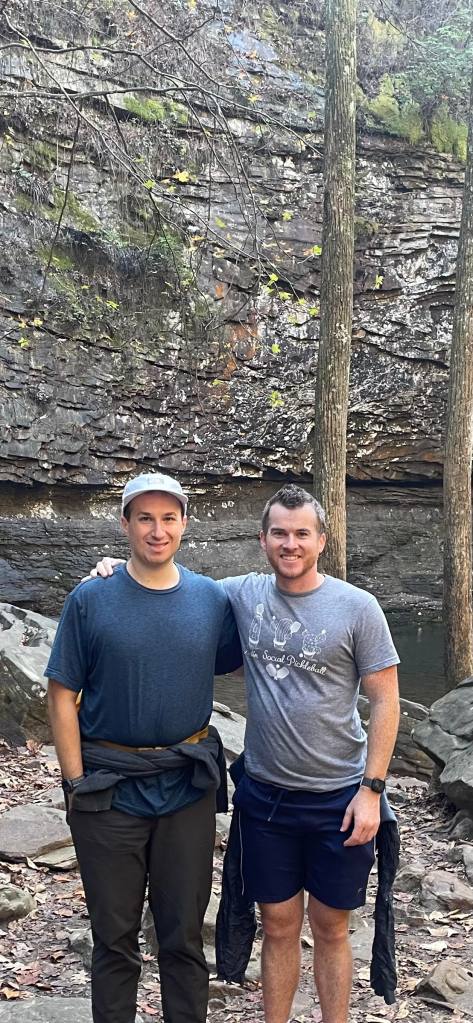
Life Update: I had a great visit with my college roommate Jordan, who lives a few hours away in Chattanooga—another place with beautiful tree game.
 The Purpose Driven Date