
I have definitely been watching too many horror movies this October. In the spirit of Halloween and to provide a fitting denouement to my previous two posts, I want to discuss Shadow. Despite the creepy imagery the word evokes, it has become a framework used in psychology and therapy.
Carl Jung was the first to discuss shadow work. Your shadows are the parts of your subconscious that unknowingly influence your life choices.
For example, you tell yourself you play video games because it’s fun. But subconsciously, you don’t feel heroic enough in everyday life, so you need to get that fix. You give your kid the iPad because it has an educational game for her to play. But, really, she is annoying the crap out of you. You sabatage good relationships because you are attached to imaginary relationships and so on.
One of the hard lessons kids must learn while growing up is that people have hidden motivations. They say one thing while doing another. It’s not just our own internal world that is dissonant with the external appearance we show off; it’s everyone elses too, which makes dealing with society insane. It’s a complex problem.
It’s not just that we misrepresent ourselves to others; worse still, we lack self-awareness of our motives.
So goes the inspiration for virtually every horror film. There is something hiding from you. Sabotaging you. Stalking you. And you don’t understand where it came from.

Every monster, ghost, and ghoul are bursting from some unknown place to make their presence known in the external world. But, Horror films are no exception to my False Dawn post. The external world is a reflection of the internal journey.
The monster is hidden in your own subconscious.
The monster is some part of yourself you don’t want to face. Some hidden belief you don’t want to admit to. Some trauma you are avoiding.
So, what is the solution? Other than the hero’s journey mumbo jumbo, I incessantly bore my readers with.
Shadow work.
The process of pulling your subconscious into your conscious. Integrating the parts of yourself, you don’t like, are ashamed of, and are controlling your perception of yourself. Who knows how to deal with it? There are a million ways. But you can’t start dealing with self-sabotage until you acknowledge its existence.
Using myself as an example, when asked what I am looking for on a date, my refrain goes, “Truth, Beauty, and Goodness.” Along with a short monologue about what those principles mean to me.
It’s a great elevator pitch, but is it true?
If I wanted to, I could write down 500 things I look for on a date. Some of them correspond with my principles. Others wouldn’t. Others still, I would be embarrassed to admit.
That act itself is Shadow work.
This gets us back to my last post about our “standard of living” outstripping our standard of living.
Human beings are finite creatures with infinite desires. Happiness comes down to our ability to control and prioritize those infinite desires. Try to capture their essence in a thoroughly practical world.
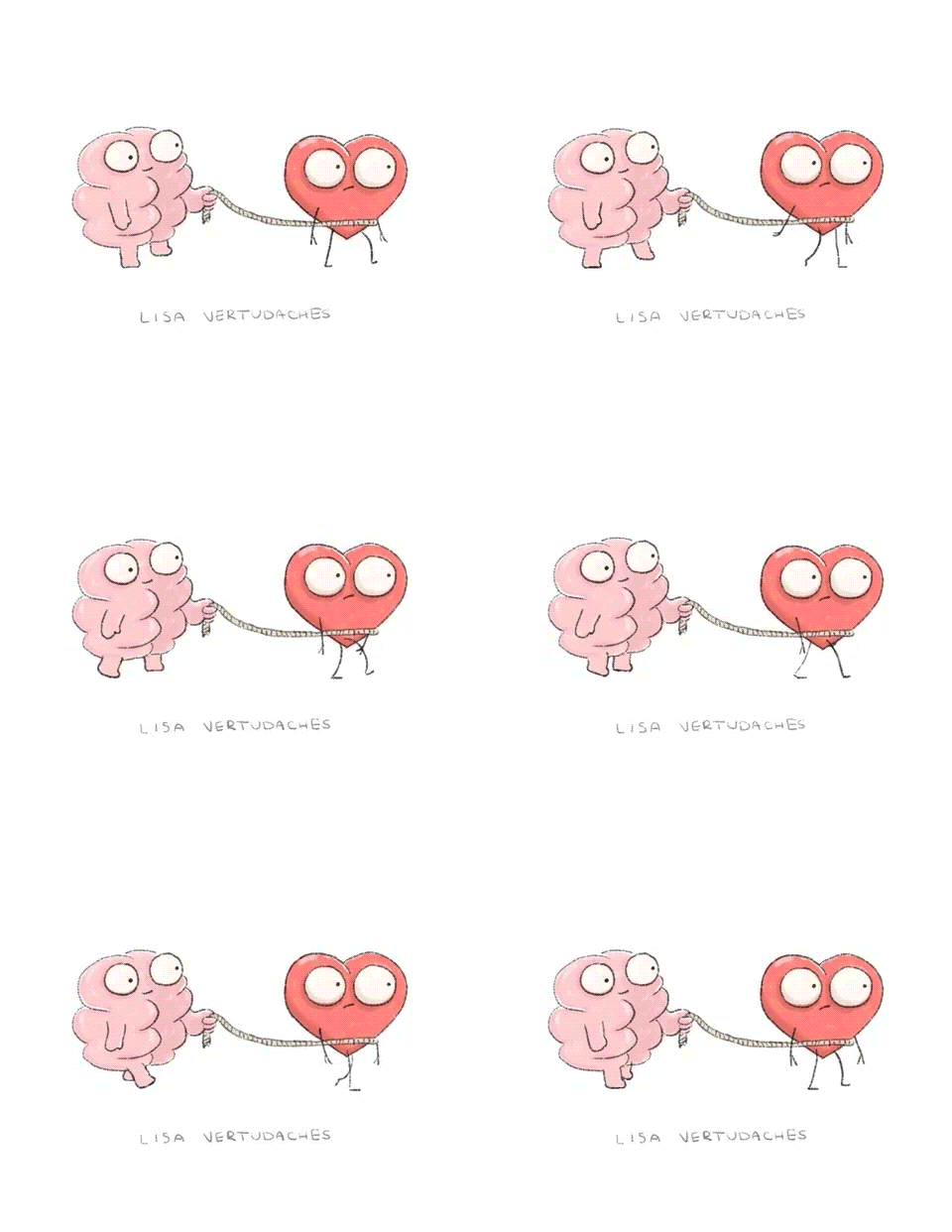
As Arthur Brooks repeatedly puts it in the podcast, the goal is “moving things from your limbic system to your pre-frontal cortex.” Putting the CEO part of your brain at the wheel and the animal part of your brain in the backseat.
Your subconscious and emotions are not bad, but there are a lot of traps. Patterns of behaviour that keep you from being the person you want to be that have to be understood at the CEO level.
But, really I was looking for a way to shoehorn my psychological babblings in a spooky seasonal way. Happy Halloween!
Life Update:
The Setting Ducks lost in the championship, further delaying my elusive volleyball title, despite the endless leagues I have played in.


 The Purpose Driven Date